
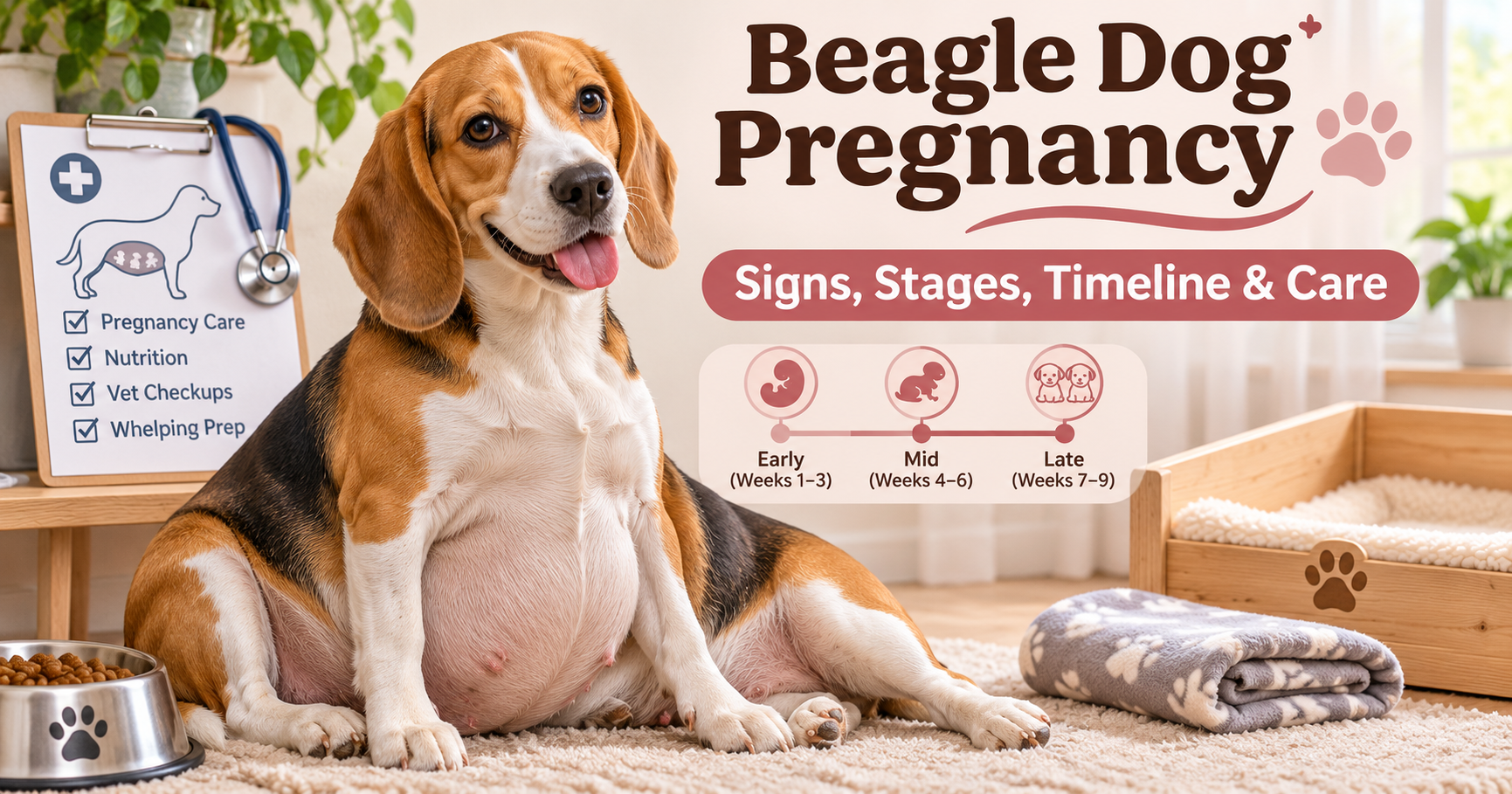
A Beagle dog pregnancy usually lasts about nine weeks. If you know the ovulation date, the expected gestation period is 62–64 days; a mating date alone gives a much broader estimate. This guide explains early pregnancy signs, the week-by-week timeline, feeding, veterinary testing, labor, and newborn care.
Quick answer: Expect around 63 days from confirmed ovulation or approximately 58–72 days from breeding when ovulation is unknown. Confirm pregnancy with your veterinarian rather than relying on symptoms, belly size or a calendar. Merck Veterinary Manual: gestation periods.
Updated: November 26, 2026. Educational content with veterinary references; not independently veterinarian-reviewed. Learn more about BeagleMix or explore our Beagle health and lifespan guides. See our editorial policy and disclaimer.
Table of contents
Beagle Pregnancy: Quick Overview
How Long Are Beagles Pregnant?
10 Signs of Beagle Pregnancy: Early to Late
Pregnant Beagle Belly Week by Week
How to Confirm Beagle Pregnancy
Beagle Pregnancy Vet Visit Schedule
Beagle Pregnancy Week by Week
Beagle Pregnancy Calculator: How to Estimate the Due Date
How Many Puppies Can a Beagle Have?
What Should You Feed a Pregnant Beagle?
Exercise and Daily Care During Pregnancy
Pregnant Beagle Daily Care Checklist
Beagle False Pregnancy vs. Real Pregnancy
How to Prepare a Whelping Box for a Beagle
How Much Does Beagle Pregnancy Care Cost?
Signs Your Beagle Is About to Give Birth
Normal vs. Abnormal Pregnancy Discharge
The Three Stages of Beagle Labor
Beagle Pregnancy Complications
When to Call an Emergency Veterinarian
Postpartum Care for the Mother Beagle
How to Care for Newborn Beagle Puppies
Can a Beagle Get Pregnant During Her First Heat?
Seven Common Beagle Pregnancy Mistakes to Avoid
Frequently Asked Questions
Final Thoughts
References
Beagle Pregnancy: Quick Overview
| Pregnancy factor | What to expect |
|---|---|
| Average pregnancy duration | 63 days from ovulation |
| Pregnancy length | Approximately 9 weeks |
| Estimated duration from mating | Approximately 58–72 days |
| Average litter size | 6 puppies |
| Possible litter size | 1–10 puppies, sometimes more |
| Noticeable pregnancy symptoms | Often around weeks 3–5 |
| Ultrasound examination | Around days 25–30 |
| X-ray for puppy count | Preferably during late pregnancy |
| Whelping preparation | Weeks 7–8 |
| Common labor signs | Nesting, restlessness and panting |
| Veterinary care | Throughout pregnancy and after delivery |
Quick answer: Most Beagles give birth around 63 days after ovulation. Veterinary pregnancy confirmation, appropriate feeding, controlled exercise, and a safe whelping environment are essential for a healthy pregnancy.
How Long Are Beagles Pregnant?
The typical Beagle pregnancy period is around nine weeks. The average Beagle gestation period is 63 days from ovulation. This is similar to the pregnancy duration of most other dog breeds.
However, calculating pregnancy from the mating date is less accurate. Canine sperm can survive for several days inside the female reproductive tract, and fertilization may occur after mating.
As a result, the delivery date can vary considerably when the exact ovulation date is unknown.
Several factors influence how accurately a delivery date can be predicted:
- Timing of ovulation
- Dates of mating
- Availability of hormone testing
- Accuracy of ultrasound measurements
- Individual reproductive health
A 2010 study of 89 female Beagles in one research colony detected no significant association between litter size or previous whelping experience and progesterone-dated gestation length. The authors noted that larger studies may be needed. Do not use litter size to predict an individual due date. See the original study.
Your veterinarian can provide a more reliable estimate using reproductive history, progesterone testing, and ultrasound measurements.
10 Signs of Beagle Pregnancy: Early to Late
Recognizing pregnancy during the first few weeks can be challenging. Some Beagles show noticeable changes, while others behave almost normally.
Beagle pregnancy signs and symptoms vary with the stage. The first five signs may occur early but are nonspecific. Weight gain, abdominal enlargement, mammary changes, reduced activity and nesting are generally more noticeable later; none confirms pregnancy.
1. Changes in Appetite
A pregnant Beagle may temporarily lose interest in food during early pregnancy. Other dogs become hungrier as their pregnancies progress.
Because Beagles are naturally food-motivated, appetite changes may be particularly noticeable. However, persistent refusal to eat requires veterinary attention.
2. Increased Sleeping
Your normally energetic Beagle may spend more time resting. Hormonal changes and the demands of pregnancy can contribute to reduced activity.
Mild tiredness may occur, but extreme weakness should never be considered a normal pregnancy symptom.
3. Enlarged Nipples
The nipples may become more prominent and develop a pinker appearance as pregnancy progresses.
These changes are often easier to notice in dogs experiencing their first pregnancy.
4. Behavioral Changes
Some pregnant Beagles become unusually affectionate and seek more attention. Others prefer quiet spaces and become less interested in social interaction.
Give your dog opportunities to rest without forcing interaction.
5. Mild Nausea
Some dogs experience temporary nausea or vomiting during early pregnancy.
Repeated vomiting, dehydration, or inability to keep food down should be evaluated by a veterinarian.
6. Gradual Weight Gain
Weight gain usually becomes more noticeable during the second half of pregnancy.
Avoid interpreting weight gain alone as confirmation. Beagles are prone to obesity, which can produce similar physical changes.
7. Abdominal Enlargement
The abdomen gradually becomes larger as the puppies develop.
A pregnant Beagle belly may become increasingly noticeable during weeks five and six, although appearance varies with body condition and litter size.
8. Mammary Gland Development
The mammary glands enlarge as the mother’s body prepares for nursing.
Milk production may become noticeable near delivery, but some mothers do not produce visible milk until after giving birth.
9. Reduced Interest in Vigorous Exercise
Your Beagle may become less interested in running, jumping, and extended outdoor activities during late pregnancy.
Gentle exercise should generally continue according to veterinary advice.
10. Nesting Behavior
As delivery approaches, your Beagle may rearrange blankets, scratch her bedding, or repeatedly visit secluded areas.
Nesting is a common sign of approaching labor but does not establish an exact delivery time.
Pregnant Beagle Belly Week by Week
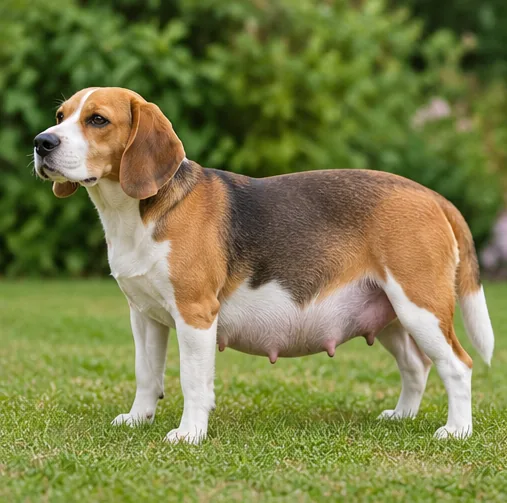
Weeks 1–3: abdominal appearance is often unchanged. Weeks 4–6: the abdomen may become more noticeable as pregnancy progresses. Weeks 7–9: enlargement may be pronounced, but litter size and body condition affect appearance. Photos and belly measurements cannot confirm gestation or predict puppy count. Sudden swelling, pain or illness requires veterinary attention.
How to Confirm Beagle Pregnancy
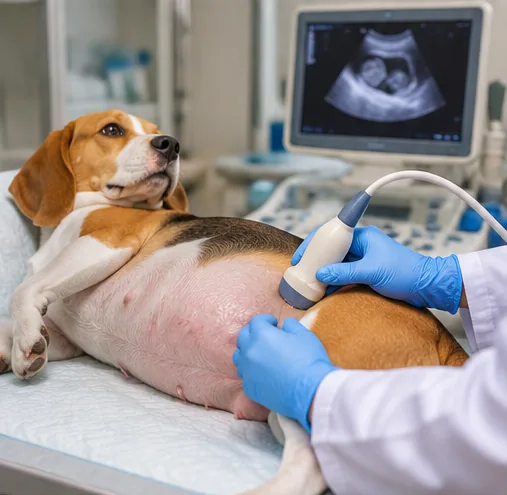
Physical symptoms alone cannot reliably confirm pregnancy.
A Beagle pregnancy test performed by a veterinarian is important because false pregnancy, obesity, and reproductive illnesses can cause similar changes.
Pregnancy Confirmation Methods
| Method | Approximate timing | Main purpose |
|---|---|---|
| Veterinary abdominal palpation | Days 21–35 | Detect developing uterine swellings |
| Relaxin blood test | Around days 25–35 | Confirm pregnancy-related hormone production |
| Ultrasound | Days 25–30 | Confirm pregnancy and assess fetal viability |
| X-ray | After approximately day 45 | Identify mineralized fetal skeletons |
| Late-pregnancy X-ray | Around days 55–58 | Obtain a more reliable puppy count |
Ultrasound can confirm pregnancy and assess fetal viability. A canine relaxin blood test may be negative if performed too early or when very few puppies are present. Ask your veterinarian whether a repeat test about a week later or ultrasound is appropriate. Read VCA’s pregnancy testing guide.
A late-pregnancy X-ray is generally more reliable for estimating litter size because individual skeletons become easier to distinguish.
Never attempt to confirm pregnancy by squeezing or pressing your Beagle’s abdomen. Leave abdominal examination to a veterinary professional.
Beagle Pregnancy Vet Visit Schedule
Arrange an initial consultation after a planned or accidental mating. Discuss confirmation testing around the fourth week; revisit diet and preventive care after confirmation. A veterinarian may recommend late-pregnancy radiographs when counting puppies is important. Before delivery, confirm the expected date and emergency arrangements. After delivery, arrange a maternal and litter check within the timeframe your veterinarian recommends.
Beagle Pregnancy Week by Week
Understanding the nine-week Beagle pregnancy timeline allows you to adjust care as the puppies develop.
The following Beagle pregnancy stages are approximate and are best interpreted alongside your veterinarian’s estimated ovulation date.
| Week | Days | Main development | Recommended care |
|---|---|---|---|
| Week 1 | 1–7 | Early fertilization and cell development | Maintain normal routine |
| Week 2 | 8–14 | Early embryonic development | Monitor health and appetite |
| Week 3 | 15–21 | Implantation and continued development | Arrange veterinary care |
| Week 4 | 22–28 | Developing organs | Pregnancy confirmation |
| Week 5 | 29–35 | Increasing fetal development | Review nutritional needs |
| Week 6 | 36–42 | Accelerated growth | Introduce smaller meals |
| Week 7 | 43–49 | Increasing abdominal size | Prepare whelping area |
| Week 8 | 50–56 | Continued puppy maturation | Arrange final veterinary checks |
| Week 9 | 57–63 | Final development and delivery preparation | Closely monitor labor signs |
Week 1: The Beginning of Pregnancy
During the first week, fertilization and early cell division take place.
Your Beagle will probably look and behave normally. There is usually no visible abdominal enlargement or reliable physical evidence of pregnancy.
Continue providing her usual balanced diet and regular gentle exercise. Record the mating dates and consult your veterinarian about pregnancy-safe medications and preventive care.
Week 2: Early Embryonic Development
The developing embryos continue dividing and moving toward the uterus.
Your Beagle may still appear completely normal. Some owners notice subtle behavioral differences, but these are not reliable indicators.
Avoid unnecessary stress, unfamiliar supplements, or sudden dietary changes. Maintain her familiar sleeping and feeding routine.
Week 3: Implantation and Hormonal Changes
During this stage, the embryos become established within the uterus and continue developing.
Some Beagles may experience appetite changes, increased tiredness, or mild nausea.
Arrange an upcoming veterinary appointment rather than relying on home pregnancy checks. Continue monitoring her normal eating, drinking, and bathroom habits.
Week 4: Veterinary Pregnancy Confirmation
Around the fourth week, pregnancy can often be confirmed through ultrasound or other appropriate veterinary testing.
Your veterinarian may assess fetal development and estimate the pregnancy stage.
Your Beagle may begin showing more noticeable nipple changes, although a large abdomen is not guaranteed.
This is a useful time to discuss a feeding plan, exercise restrictions, and anticipated delivery preparations.
Week 5: Visible Physical Development
The puppies continue developing rapidly, and your Beagle’s body may begin changing more noticeably.
Her abdomen may become rounder, and her appetite may increase.
Discuss gradually introducing a nutritionally complete diet suitable for pregnancy and lactation. Avoid increasing food portions excessively because obesity can make pregnancy and delivery more complicated.
Week 6: Rapid Puppy Growth
The developing puppies require increasing nutritional support.
Your Beagle may find large meals uncomfortable because her expanding uterus occupies more abdominal space.
Offer several smaller meals instead of one or two large servings. Keep fresh water available and provide comfortable resting areas.
Short, controlled walks are generally preferable to demanding exercise.
Week 7: Preparing for Delivery
By week seven, your Beagle may have a considerably larger abdomen.
She might spend more time resting and become less interested in strenuous activities.
Prepare a whelping box in a quiet area of your home. Allow her to explore it voluntarily so that she associates it with comfort and security.
Ask your veterinarian when a late-pregnancy X-ray would be most appropriate.
Week 8: Final Puppy Development
The puppies continue maturing as the expected delivery date approaches.
Your Beagle may appear uncomfortable when changing sleeping positions. She may prefer smaller meals and more frequent bathroom breaks.
Complete your delivery preparations, confirm emergency veterinary contact information, and discuss any individual pregnancy risks.
Avoid leaving her unattended for extended periods.
Week 9: Labor and Whelping
During the final week, your Beagle may become restless, lose interest in food, pant more frequently, or show strong nesting behavior.
A temporary decrease in rectal temperature may occur before delivery, although this is not reliable in every dog.
Follow your veterinarian’s monitoring instructions and ensure transportation is immediately available if complications develop.
Beagle Pregnancy Calculator: How to Estimate the Due Date
Estimate your Beagle’s due date
Select a date to calculate.
Educational estimate only. A breeding date gives a broad range; never use this tool to schedule surgery, induce labor, or delay emergency care.
A Beagle pregnancy calculator provides an approximate Beagle due date based on reproductive timing, not a confirmed delivery appointment.
The basic formula is:
Estimated delivery date = Ovulation date + 63 days
If only the mating date is available, adding 63 days provides a rough estimate rather than a confirmed due date.
| Known date | Calculation | Accuracy |
|---|---|---|
| Confirmed ovulation | Add approximately 63 days | Higher |
| First mating | Add approximately 63 days | Lower |
| Multiple mating dates | Consider the full mating window | Variable |
| Veterinary ultrasound | Use professional measurements | Depends on pregnancy stage |
For example, if ovulation occurred on January 1, the estimated due date would be March 5 in a non-leap year.
A calendar calculation cannot determine whether the puppies are mature enough to be delivered. Never use a pregnancy calculator to decide when to induce labor or schedule surgery without veterinary assessment.
How Many Puppies Can a Beagle Have?
The American Kennel Club describes Beagle litters as commonly ranging from one to ten puppies, averaging about six. These figures are descriptive, not a guarantee or a safe delivery target. AKC breed information.
Litter size may be influenced by the mother’s age, genetics, reproductive health, mating timing, and other biological factors.
During a Beagle’s first pregnancy, she may have a small or large litter. Previous pregnancy experience alone cannot predict the number of puppies.
An unusually small litter is not necessarily easier to deliver. A single puppy may grow relatively large or fail to provide sufficient signals for normal labor.
Likewise, a very large litter may place additional physical demands on the mother.
A late-pregnancy X-ray helps establish how many puppies are expected, allowing you and your veterinarian to recognize when delivery may be incomplete.
What Should You Feed a Pregnant Beagle?

A pregnant Beagle diet should support fetal development, maternal health and future milk production.
Beagles have enthusiastic appetites and can gain unnecessary weight easily. The goal is to provide sufficient nutrients without encouraging excessive weight gain.
First Three Weeks
Most healthy Beagles do not require a substantial increase in calories during early pregnancy.
Continue feeding an appropriate, nutritionally complete diet unless your veterinarian recommends changes.
Weeks Four to Six
Discuss switching to a complete diet labeled for gestation and lactation or all life stages. Do not assume every growth formula is suitable; check the nutritional adequacy statement and your veterinarian’s recommendation. VCA pregnancy nutrition guidance.
Select a complete and balanced formula rather than relying on homemade supplements or unbalanced meals.
Weeks Seven to Nine
Energy requirements increase during late pregnancy.
Because the expanding uterus reduces available abdominal space, smaller, more frequent meals may help your Beagle eat comfortably.
Your veterinarian should determine portion sizes based on her body condition, current diet, weight, and estimated litter size.
Beagle Pregnancy Feeding Chart
| Pregnancy stage | Feeding approach | Meal frequency |
|---|---|---|
| Weeks 1–3 | Maintain appropriate baseline intake | 2 meals daily |
| Weeks 4–5 | Review diet and transition if advised | 2–3 meals daily |
| Weeks 6–7 | Gradually increase intake as needed | 3–4 meals daily |
| Weeks 8–9 | Offer smaller, energy-dense meals | 3–4 meals or as advised |
| Nursing stage | Adjust for milk production and body condition | Frequent meals or supervised free feeding |
These are general feeding suggestions rather than universal serving requirements.
Important Nutritional Precautions
Do not give a pregnant Beagle calcium tablets, high-dose vitamins, or human nutritional supplements without veterinary approval.
Unnecessary calcium supplementation during pregnancy may interfere with the body’s ability to regulate calcium and contribute to complications during nursing.
Avoid raw diets with potential bacterial contamination, cooked bones, and foods toxic to dogs, including chocolate, grapes, raisins, onions, and products containing xylitol.
Clean drinking water should always be available.
Exercise and Daily Care During Pregnancy
A healthy pregnant Beagle generally benefits from appropriate physical activity.
During early pregnancy, most dogs can continue their familiar walking routine. As pregnancy progresses, exercise should become less demanding.
Short leash walks are especially useful for Beagles because their strong scent-tracking instincts may lead them away from safe areas.
Avoid rough play, intense running, repeated jumping, overheating, and unfamiliar dogs that could transmit infections.
Provide a comfortable sleeping area, non-slip flooring, easy access to water, and opportunities for frequent bathroom breaks.
Do not introduce flea treatments, deworming products, medications, or herbal remedies without confirming that they are appropriate during pregnancy.
Pregnant Beagle Daily Care Checklist

Record appetite, water intake, activity, unusual discharge, medications and any concerns. Offer measured meals, fresh water, short controlled walks and a comfortable resting place. Keep emergency contact and transport details accessible. Avoid giving supplements or medication without veterinary approval.
Beagle False Pregnancy vs. Real Pregnancy
False pregnancy, also called pseudopregnancy, occurs when an unspayed female dog develops pregnancy-like symptoms despite not carrying puppies.
Hormonal changes following a heat cycle can cause this condition even if the dog has never mated.
| Symptom | Real pregnancy | False pregnancy |
|---|---|---|
| Enlarged nipples | Possible | Possible |
| Nesting behavior | Common near delivery | Possible |
| Milk production | Possible | Possible |
| Behavioral changes | Possible | Possible |
| Abdominal enlargement | Possible | Possible |
| Developing puppies on ultrasound | Present when detectable | Absent |
| Positive pregnancy-specific relaxin test | Usually present at the appropriate stage | Absent |
Do not assume that your Beagle is pregnant simply because she produces milk or collects toys as though they were puppies.
A veterinarian can distinguish false pregnancy from genuine pregnancy and rule out serious reproductive conditions such as pyometra, a potentially life-threatening uterine infection.
If your dog becomes unusually thirsty, develops vaginal discharge, vomits, or appears seriously unwell after a heat cycle, seek veterinary care promptly.
How to Prepare a Whelping Box for a Beagle

A Beagle whelping box provides a designated space where your dog can deliver and nurse her puppies.
Prepare it approximately one to two weeks before the expected delivery date.
Choose a quiet, draft-free location away from household traffic. The box should be large enough for your Beagle to lie fully stretched out, turn comfortably, and nurse her puppies.
Use clean, flat, washable bedding that does not easily bunch around newborn puppies. Properly installed anti-crush rails may help reduce the risk of puppies becoming trapped against the sides.
Use a thermostatically controlled, veterinarian-approved warming setup. Newborn puppies cannot regulate temperature well or reliably escape a hot surface. Monitor bedding-level temperature and the puppies directly; avoid uncontrolled heating pads or direct contact with heat sources.
Introduce your Beagle to the box gradually. Never force her to remain inside when she is uncomfortable.
Beagle Whelping Supplies Checklist
Prepare these items before delivery:
- Clean towels and washable bedding
- A suitable whelping box
- A digital puppy weighing scale
- A veterinarian-approved thermometer
- Disposable gloves
- A safe, temperature-controlled warming arrangement
- A notebook for recording delivery details
- Fresh drinking water
- Your veterinarian’s emergency telephone number
- A clean transport carrier for the puppies
- An emergency transportation plan
Discuss newborn resuscitation and emergency care with your veterinarian before the due date rather than attempting unfamiliar procedures during labor.
How Much Does Beagle Pregnancy Care Cost?
Costs vary widely by location, clinic, timing, and complications. Request a written estimate for examination, pregnancy confirmation, imaging, follow-up, emergency delivery or cesarean surgery, and newborn examinations. Ask about after-hours fees and payment arrangements in advance. No universal price is reliable.
Signs Your Beagle Is About to Give Birth
If your Beagle is giving birth soon, you may observe behavioral and physical changes.
Common Beagle labor signs include persistent nesting, pacing, panting, trembling, reduced appetite, increased licking of the genital area, and difficulty settling.
Some dogs experience a temporary rectal temperature decrease to around 99°F (37.2°C) or below before delivery.
However, not every dog experiences an obvious temperature drop, and a single reading cannot reliably establish when labor will begin.
If your veterinarian recommends temperature monitoring, follow their instructions and avoid relying on temperature alone.
Keep the environment peaceful and observe your Beagle without repeatedly disturbing her.
Normal vs. Abnormal Pregnancy Discharge
Discharge alone cannot establish whether a pregnancy is progressing normally. Call your veterinarian about new discharge during pregnancy. Green discharge before the first puppy, heavy bleeding, a foul odor or discharge accompanied by pain, fever or weakness requires urgent veterinary assessment. Some discharge after delivery can be expected, but deterioration or an unpleasant smell is a warning sign.
The Three Stages of Beagle Labor
Stage 1: Early Labor
During the first stage, the uterus begins contracting and the cervix prepares for delivery.
Your Beagle may pant, pace, tremble, refuse food, or repeatedly rearrange her bedding.
Visible abdominal pushing is generally absent during this stage.
Early labor commonly lasts several hours. Contact your veterinarian if it continues unusually long without progression or your dog appears distressed.
Stage 2: Puppy Delivery
During active labor, abdominal contractions become visible and the puppies are delivered.
Healthy puppies may arrive relatively close together, although resting periods between births can occur.
Record each puppy’s birth time and observe the mother’s condition.
Do not pull on a puppy, insert instruments, or administer labor-inducing medication unless directly instructed by a veterinarian.
Stage 3: Placenta Delivery
The placentas are expelled during and after puppy delivery.
Placenta delivery does not necessarily follow a strict one-puppy, one-placenta sequence. The mother may also consume placentas before you notice them.
Record what you observe and inform your veterinarian if you suspect incomplete delivery.
Beagle Pregnancy Complications
Difficult birth can result from ineffective contractions, obstruction or fetal problems. Maternal infection, mastitis and eclampsia can also threaten the mother or puppies, particularly around or after delivery. A singleton, unusually large litter, prior difficult birth or poor body condition may require closer monitoring. Your veterinarian should determine the delivery plan.
When to Call an Emergency Veterinarian
Difficult labor, known as dystocia, can threaten both the mother and her puppies.
Contact an emergency veterinarian immediately if you notice any of the following:
| Warning sign | Recommended action |
|---|---|
| Strong pushing for 20–30 minutes without a puppy | Emergency veterinary care |
| Green discharge before the first puppy or without prompt delivery | Contact the veterinarian immediately |
| A puppy or fetal membrane appears stuck | Emergency veterinary care |
| Two hours between puppies when more are expected (call for advice promptly) | Contact the veterinarian |
| Heavy vaginal bleeding | Emergency veterinary care |
| Foul-smelling discharge | Urgent veterinary examination |
| Collapse, severe pain or weakness | Emergency veterinary care |
| No delivery within 24 hours of a documented temperature drop | Contact the veterinarian |
| Pregnancy progressing beyond the veterinary due date | Contact the veterinarian for assessment |
A veterinarian may recommend imaging, medical treatment, or a cesarean section depending on the situation.
Never attempt to treat difficult labor with calcium, oxytocin, or human medication at home.
Emergency warning: Contact an emergency veterinarian immediately for unproductive strong contractions lasting 20–30 minutes, weak contractions for 1–2 hours without progress, a stuck puppy or membrane, heavy bleeding, foul odor, a temperature above 103°F (39.4°C), or severe distress. Do not wait for a calculator deadline or give labor-inducing medicines yourself. Cornell: difficult births.
Postpartum Care for the Mother Beagle
The mother’s recovery is just as important as pregnancy care.
After delivery, arrange a veterinary examination for the mother and puppies, ideally within the first 24–48 hours or sooner if concerns arise.
Provide a clean, quiet nursing area, fresh drinking water, and a nutritionally appropriate diet that supports milk production.
Check that your Beagle is eating, drinking, nursing, and behaving comfortably.
Some vaginal discharge is expected following delivery, but it should gradually decrease and should not develop an unpleasant odor.
Watch for fever, painful mammary glands, unusual swelling, refusal to nurse, severe lethargy, or persistent panting.
Tremors, muscle stiffness, restlessness, and seizures can indicate eclampsia, a dangerous complication involving low blood calcium. These symptoms require immediate veterinary treatment.
How to Care for Newborn Beagle Puppies
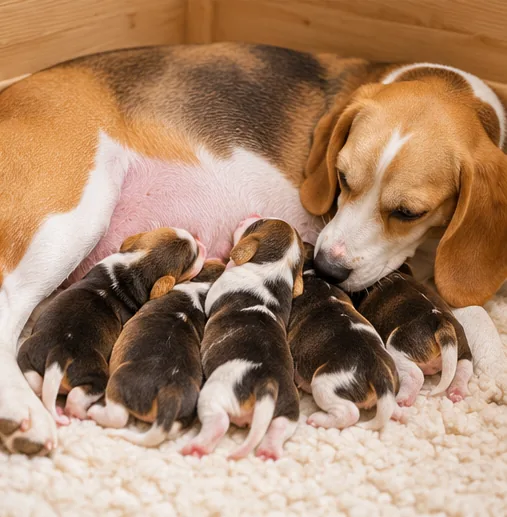
Newborn Beagle puppies depend completely on their mother and their surroundings.
They cannot regulate their body temperature effectively during early life and require a warm, clean environment.
Ensure that every puppy has an opportunity to nurse. The mother’s first milk, known as colostrum, provides important early immune protection.
Use a digital scale to record each puppy’s birth weight and monitor its weight at least daily.
Track each puppy individually at the same time each day. A failure to gain weight, weight loss, coldness or poor nursing warrants a prompt call to the veterinarian; do not wait for a fixed percentage target. VCA newborn care guidance.
Contact your veterinarian if a puppy repeatedly cries, fails to nurse, loses weight, feels unusually cold, or becomes weak.
If supplemental feeding is necessary, use a commercial canine milk replacer and follow veterinary instructions. Ordinary cow’s milk is not an appropriate replacement.
Can a Beagle Get Pregnant During Her First Heat?
Yes. A female Beagle can become pregnant during her first heat cycle because sexual maturity may occur before full physical maturity.
However, responsible breeding should not take place simply because pregnancy is biologically possible.
Early pregnancy can impose significant physical and nutritional demands on a developing dog.
Before planned breeding, arrange a veterinary reproductive assessment and appropriate breed-specific genetic and health screening for both parents.
Owners who do not intend to breed should discuss spaying and preventing accidental mating with their veterinarian.
Seven Common Beagle Pregnancy Mistakes to Avoid
- Overfeeding too early: Excess weight may increase delivery difficulties.
- Skipping veterinary pregnancy confirmation: Symptoms alone cannot distinguish real and false pregnancy.
- Giving unnecessary supplements: Calcium and vitamin supplementation can create nutritional imbalances.
- Allowing strenuous late-pregnancy exercise: Choose controlled activities appropriate for your dog’s condition.
- Ignoring changes in vaginal discharge: Abnormal discharge may indicate infection or pregnancy complications.
- Preparing the whelping area too late: Give your Beagle time to become comfortable with the location.
- Waiting too long during difficult labor: Prompt professional assessment can save the mother and her puppies.
Frequently Asked Questions
1. How long does Beagle dog pregnancy last?
A Beagle pregnancy generally lasts approximately 63 days from ovulation. Beagle pregnancy duration calculated from mating can be longer or shorter because fertilization does not necessarily occur on the mating date. Merck gives a 62–64 day interval after ovulation; a breeding date alone is less precise.
2. How can I tell if my Beagle is pregnant?
Possible signs include nipple enlargement, appetite changes, increased resting, weight gain, and abdominal enlargement. Veterinary ultrasound or appropriate blood testing provides more reliable confirmation. Do not use abdominal pressure or home tests to confirm pregnancy.
3. When does a pregnant Beagle start showing?
Many Beagles develop noticeable abdominal enlargement during weeks four to six. Dogs carrying small litters may show later or less visibly. Belly size cannot establish fetal health or litter size.
4. How many puppies does a Beagle usually have?
The average Beagle litter contains approximately six puppies, although individual litters may contain considerably fewer or more. A late-pregnancy veterinary X-ray may help estimate the number.
5. Can a pregnant Beagle go for walks?
Yes. Gentle, controlled walks are generally beneficial for healthy pregnant dogs. Reduce exercise intensity as pregnancy progresses and follow your veterinarian’s advice. Avoid overheating and adjust activity to the mother’s condition.
6. Can I feed my pregnant Beagle puppy food?
A suitable complete and balanced growth or reproduction formula may be appropriate during pregnancy and lactation. Ask your veterinarian to recommend the correct food and feeding schedule. Look for a gestation/lactation or all-life-stages nutritional adequacy statement.
7. Do Beagles need C-sections?
Not every Beagle requires a cesarean section. However, emergency or planned surgery may be necessary if there is fetal distress, obstructed labor, abnormal puppy positioning, or another medical concern. A veterinarian must decide whether surgery is indicated.
8. Is it normal for a pregnant Beagle to sleep more?
Some increase in resting is common, particularly during late pregnancy. Severe lethargy, weakness, or refusal to eat should be investigated. A sudden or marked change should prompt a veterinary call.
9. Can a Beagle have only one puppy?
Yes. Singleton pregnancies are possible. They may require additional monitoring because a single puppy can be associated with particular delivery risks. Ask your veterinarian about the additional delivery risks of singleton pregnancy.
10. Can I use a human pregnancy test on my Beagle?
No. Human pregnancy tests detect a hormone that is not used to diagnose canine pregnancy. Veterinarians use canine-specific relaxin testing, ultrasound, and other appropriate examinations. Early canine-specific tests can also return false negatives.
11. Can a Beagle have a false pregnancy?
Yes. Hormonal changes after a heat cycle can produce nesting, mammary development, milk production, and other pregnancy-like symptoms without developing puppies. Illness or abnormal discharge after a heat cycle needs prompt assessment.
12. What should I do if my Beagle has passed her due date?
Contact your veterinarian. The urgency depends on how the pregnancy was dated, the mother’s condition, and the puppies’ development. Do not attempt to induce labor at home. Seek immediate care if difficult-labor signs occur, regardless of the estimated date.
Final Thoughts
Beagle dog pregnancy typically lasts around nine weeks and involves significant physical, nutritional, and behavioral changes.
By understanding the pregnancy timeline, recognizing potential complications, maintaining appropriate nutrition, and preparing a safe delivery environment, you can support your Beagle throughout this important period.
Remember that each pregnancy is different. A healthy pregnancy is not determined solely by belly size, appetite, or an estimated delivery date.
Regular veterinary care, responsible breeding decisions, and timely emergency intervention remain the most important steps in protecting the mother and her puppies.
Veterinary disclaimer: This article is intended for general educational purposes and does not replace professional veterinary advice, diagnosis, or treatment.
References
- Cornell University College of Veterinary Medicine — Normal whelping process
- Cornell University — Dystocia in dogs
- Merck Veterinary Manual — Approximate gestation periods
- VCA — Pregnancy testing
- VCA — Feeding the pregnant dog
- VCA — Caring for newborn puppies
- AKC — Beagle litter size
- Canadian Journal of Veterinary Research — Beagle gestation study